Created for real underwater, remote, industrial and regulated environments—not adapted from a generic office workflow.
PROPRIETARY · HUMAN-REVIEWED · FIELD-ENGINEERED
ATHENA™.
Operational intelligence.
Ven-Tech’s Artificial Tactical HSE Engineering & Navigation Assistant brings risk, logistics, standards, inspection planning and project documentation into one controlled workflow for complex field operations.

A™
Developed in-house for Ven-Tech operations
HSERisk controls
OPSMission planning
DATAInspection logic
QAHuman review
Built from field experience
One operating layer.
Many difficult missions.
ATHENA™ turns Ven-Tech’s field knowledge into a repeatable planning and documentation system—without removing human authority.
Developed in-house, ATHENA™ supports the team from early scope definition through risk review, logistics, method selection, document preparation, field execution and closeout. It is designed around the realities of commercial diving, remote robotics, reservoir work, pipe inspection, survey, UAS and multi-method projects.
The platform structures information and provides controlled prompts. Qualified personnel verify current requirements, challenge assumptions, approve the plan and retain stop-work and field decision authority. That combination—stronger preparation plus accountable human judgment—is the heart of ATHENA™.
Mission-specific logicQualified human reviewTraceable project records
Project logic changes with the asset, method, jurisdiction, hazard, crew, environment and required deliverable.
Assumptions, reviews, approvals, revisions and evidence remain connected to the active project record.
ATHENA™ supports the assigned experts; it does not autonomously authorize or control high-risk work.
ATHENA core capabilities
From mission inputs.
To controlled execution.
Six connected modules help Ven-Tech structure the technical, safety, logistics and evidence requirements around the actual asset and task.
Risk Intelligence Engine™
Structures the known operational variables—asset geometry, depth, access, visibility, flow, contamination, stored energy, communications and recovery time—into a project-specific hazard and control review.
Dive & task logic modules
Organizes work steps, equipment, crew roles, bottom-time considerations, redundancy, hold points and task-specific controls for diving, ROV, pipe, reservoir and marine scopes.
Regulatory alignment map
Links the planned work to the relevant jurisdiction, client rules, internal procedures and applicable standards without replacing the competent person responsible for final interpretation and authorization.
ROV & survey data planning
Supports route, waypoint, sonar, imaging, photogrammetry and evidence-planning decisions around known geometry, obstructions, visibility and the required engineering deliverable.
Logistics & mobilization logic
Builds repeatable mobilization checks around crew, equipment, transport, load sequence, spares, communications, weather, fuel, resupply and remote-site contingencies.
Smart document generation
Assembles controlled drafts for safety plans, JHAs, rescue procedures, permits, disinfection records, decontamination plans, inspection registers and project closeout documentation.
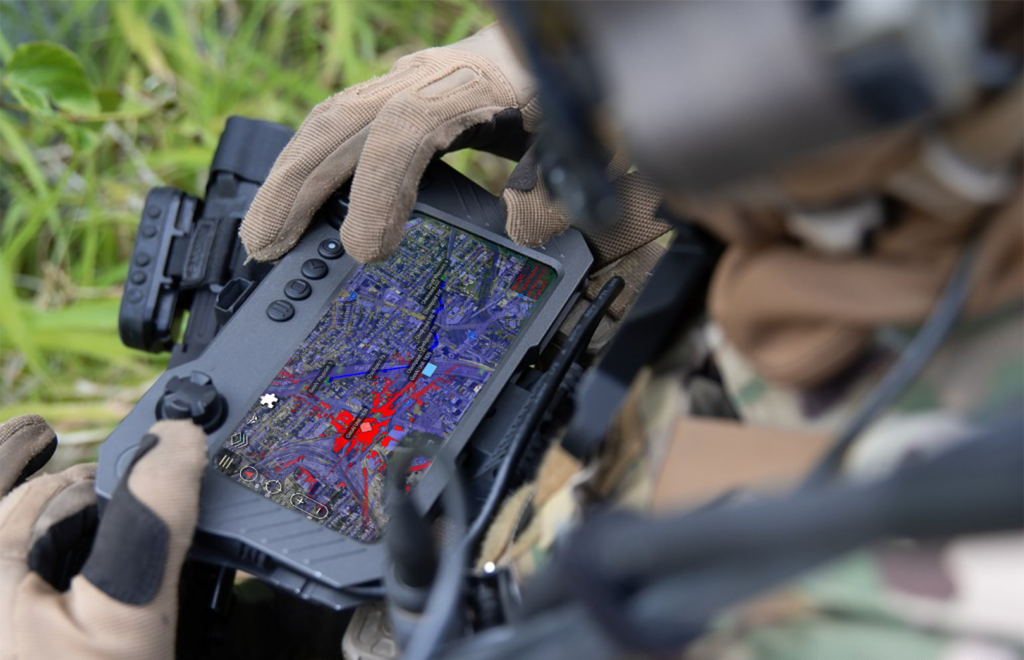
Field intelligence, not generic AI
Context first.
Action second.
ATHENA™ begins with the mission: what must be accomplished, what is known, what remains uncertain and who has authority.
It can organize complex inputs into a stronger first planning package, but every output is treated as a controlled draft until the responsible Ven-Tech personnel verify the site, standards, assumptions, equipment, crew and client interfaces.
- 01 Scope and operating conditions captured
- 02 Hazards and missing information made visible
- 03 Controls and documents proposed for review
- 04 Qualified people approve and lead execution
Operational domains
One platform.
Across the fleet.
ATHENA™ supports integrated planning when the safest or most useful answer requires diving, robotics, UAS, survey, pipe or multiple methods together.
01
Commercial diving
Dive planning, roles, equipment, communications, emergency readiness and task-specific field controls.
↗02ROV & robotic inspection
Mission routes, payload selection, tether considerations, imaging coverage, sonar and remote intervention planning.
↗03Reservoir services
Potable-water protection, disinfection workflows, diver or robotic options, inspection coverage and water-quality records.
↗04Pipe inspection
Crawler configuration, access, distance, communications, sensor packages, coding and decision-ready inspection records.
↗05UAS operations
Airspace, operating-category, site, weather, payload, crew, ground-risk and emergency-planning checks for Canadian missions.
↗06Survey & mapping
Coverage, positioning, control, sensor configuration, coordinate reference, quality checks and required geospatial outputs.
↗07Confined space
Entry interfaces, atmospheric hazards, isolation, rescue, communications and remote-inspection alternatives.
↗08Remote infrastructure
Mobilization, resupply, weather, communications, medevac, spare equipment and operational continuity for difficult locations.
↗Controlled functional architecture
Structured logic.
Visible accountability.
ATHENA™ combines modular planning logic, task-specific prompts and controlled templates with Ven-Tech’s review and authorization process.
01
Operational inputAsset, environment, task, hazards, client rules and required outputs.
02
Logic and gap analysisRelevant prompts, dependencies, unknowns and proposed controls.
03
Qualified reviewCompetent personnel validate requirements, assumptions and technical methods.
04
Approved field packageAuthorized plans, checklists, records, hold points and emergency arrangements.
05
Closeout and learningEvidence, revisions, lessons and approved improvements returned to the system.
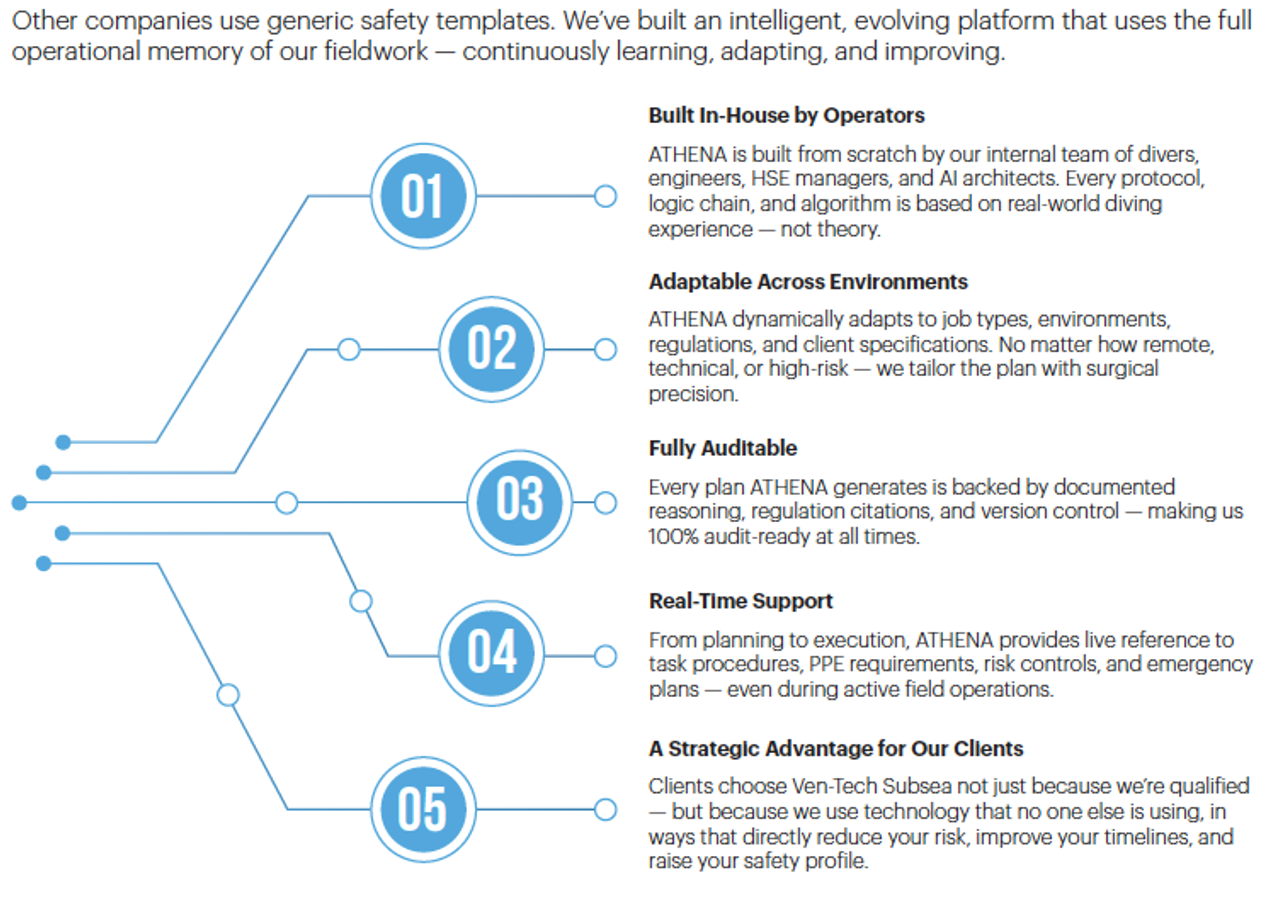
ATHENA project workflow
Six stages.
One controlled record.
From the first asset conversation to project closeout, ATHENA™ helps maintain continuity without hiding the human decisions that govern the work.
Capture the mission
Asset, objective, location, operating state, known hazards, client requirements, schedule and deliverables are entered into a controlled scope record.
Structure the risk
ATHENA™ organizes known variables, identifies information gaps and proposes applicable planning prompts, controls and decision points.
Apply qualified judgment
A competent Ven-Tech lead reviews the assumptions, verifies current requirements and edits the proposed plan for the actual site and task.
Approve the field package
Responsible supervisors and client representatives review the required documents, interfaces, hold points and emergency arrangements before mobilization or execution.
Use it in the field
The approved package guides briefings, inspections, checklists, communications and change management while field authority remains with the assigned team.
Close the feedback loop
Field records, observations, non-conformances and lessons learned inform controlled updates to future planning templates and logic.
Smart document support
Build the package.
Keep the reasoning.
Controlled drafts help teams move faster while review, revision and approval remain visible and project-specific.
Dive safety plans & JHAs
Scope-specific hazards, roles, equipment, safe-work steps, hold points and control verification.
Emergency & rescue plans
Communications, recovery, standby capability, medical pathway, evacuation and scenario actions.
Confined-space packages
Entry permits, atmospheric testing, isolation, attendant, rescue and coordination requirements.
Disinfection & decontamination
Potable-water equipment controls, concentration records, contamination zones and equipment-release criteria.
Inspection execution records
Coverage plans, media indexes, readings, findings, limitations, corrective actions and approvals.
Audit-ready project files
Approved revisions, briefings, field changes, evidence, client records and lessons learned in one traceable package.
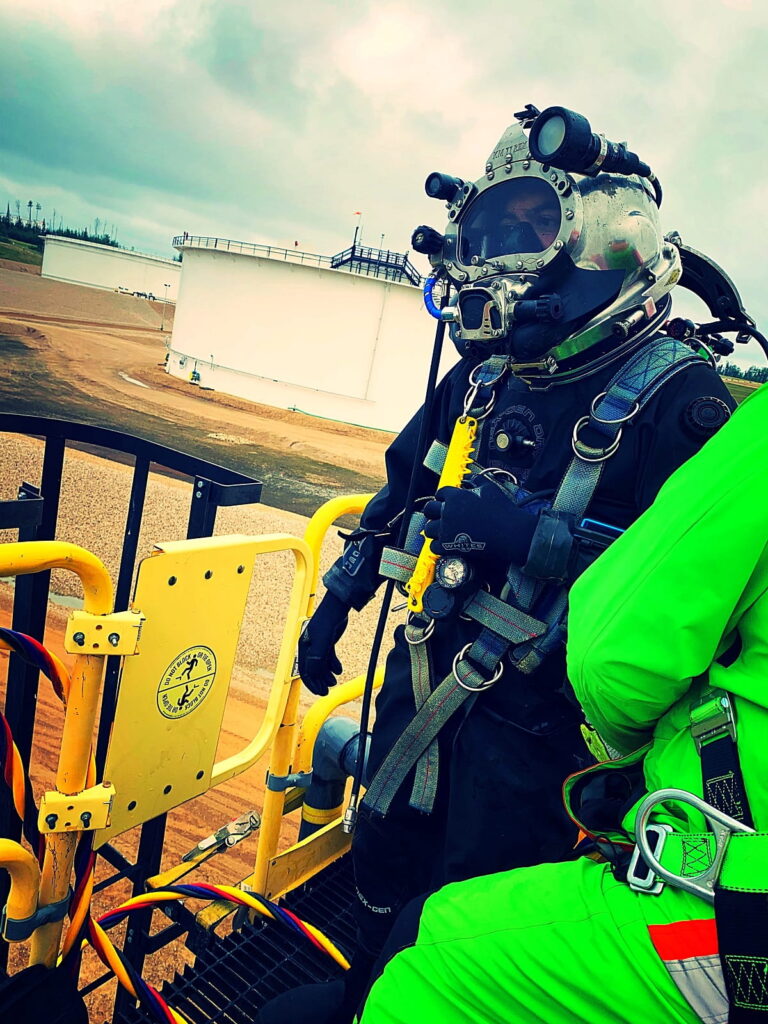 DIVING / FIELD EXECUTION
Built for demanding environments
Support the crew.
Strengthen the mission.
Commercial-diving work brings changing water conditions, stored energy, access, communications, life-support, rescue and client operations into one tightly controlled system.
ATHENA™ helps the team prepare that system before the dive and keep the approved controls connected to field briefings, checklists, change management and final records.
Explore Commercial Diving →Client outcomes
Better preparation.
More useful evidence.
ATHENA™ is valuable when it improves the quality, consistency and traceability of the actual project—not when it simply produces more paperwork.
Planning consistency
Repeatable prompts and controlled templates reduce the chance that a critical interface is missed when scopes, teams or locations change.
Faster technical preparation
Structured mission inputs help teams assemble a strong first draft earlier, leaving more time for qualified review and site-specific refinement.
Better field communication
Clear roles, hold points, contingencies and inspection objectives improve alignment between supervisors, operators, clients and support teams.
Stronger inspection evidence
Coverage, media, measurements and limitations are planned around the client’s decision instead of being organized only after the work is complete.
Audit-ready traceability
Approved documents, field revisions and final evidence remain connected, helping clients understand what was planned, completed and discovered.
Integrated methods
Diving, robotics, UAS, survey and pipe technology can be compared within one planning framework when a hybrid approach can reduce risk or improve evidence.
ATHENA in action
Complex inputs.
Practical field plans.
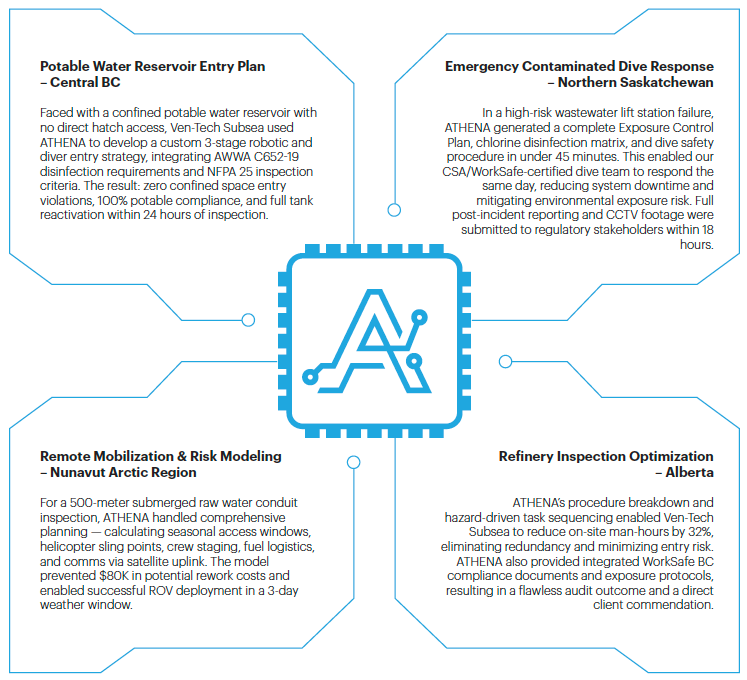
Existing Ven-Tech applications include potable-water access, wastewater and contaminated environments, remote mobilizations, reservoir work, submerged pipelines, refinery infrastructure, hydro assets and mixed diver/robotic inspection programs.
Potable reservoir disinfection and access planningWastewater exposure-control and decontamination planningRemote Arctic mobilization and contingency logicIndustrial inspection sequencing and worksite interfaces
Standards intelligence
Reference the rule.
Verify the application.
ATHENA™ can organize requirements and planning prompts, but the project team verifies the current source, jurisdiction, edition, contract and site application before approval.
- CSA Z275.2 / Z275.4 commercial-diving practices
- CSA Z1006 confined-space framework
- Canadian Aviation Regulations and Transport Canada RPAS requirements
- WorkSafeBC OHS Regulation—including Parts 9 and 24 where applicable
- AWWA C652 potable-water storage workflows
- NFPA 25 fire-water inspection framework
- NASSCO PACP pipe-inspection coding
- IMCA guidance where contractually applicable
- Client operating procedures and permit systems
- ISNetworld, Avetta, Cognibox and COR® contractor controls
Responsible operational AI
Intelligence with
clear boundaries.
High-risk work requires transparent authority, verified requirements and traceable review. ATHENA™ is designed to reinforce those controls.
Human authority
ATHENA™ supports decisions; it does not replace the supervisor, pilot, engineer, safety professional, client authority or competent person accountable for the work.
Current-source verification
Applicable laws, standards, client rules and site information are verified for the project. Generated content is not treated as a substitute for current source documents.
Controlled inputs
Plans are only as reliable as the asset, hazard and operating information available. Assumptions and missing information remain visible for review.
Revision control
Drafts, reviews, approvals and field changes are tracked so teams can identify the active version and understand what changed.
Data stewardship
Client information is handled within Ven-Tech’s approved operational and access controls, with project-specific data-sharing requirements confirmed before use.
Continuous improvement
Field feedback improves controlled templates and logic only after review, preventing an unverified field observation from silently becoming a standard instruction.
Contractor assurance
A digital platform.
Inside a qualified system.
ATHENA™ operates within Ven-Tech’s health, safety, quality and contractor-management framework. Technology supports the management system; it does not stand outside it.
BCCSA COR® CertifiedISNetworld Member ContractorISNetworld ESG BadgeAvetta ApprovedCognibox CertifiedAlcumus SafeContractorCommercial-diving proceduresTransport Canada RPAS frameworkNASSCO PACP capabilityCWB / CSWIP inspection capabilityRegional WCB coverageProject-specific quality control
ATHENA FAQ
Operational intelligence.
Clearly explained.
ATHENA™ is an in-house Ven-Tech capability used to improve project planning, field consistency and documentation.
What is ATHENA™?+
ATHENA™—Artificial Tactical HSE Engineering & Navigation Assistant—is Ven-Tech’s proprietary operational intelligence platform. It structures project information, risk prompts, logistics, inspection planning and controlled document drafts for diving, robotics, reservoir, pipe, UAS, survey and remote-infrastructure work.
Does ATHENA™ replace supervisors or qualified professionals?+
No. ATHENA™ is a decision-support and documentation platform. Final interpretation, planning, authorization and field control remain with the qualified supervisors, pilots, engineers, safety professionals, client authorities and competent people assigned to the project.
What documents can ATHENA™ support?+
Depending on the scope, ATHENA™ can support controlled drafts for dive safety plans, JHAs, emergency and rescue procedures, confined-space permits, disinfection logs, decontamination plans, inspection coverage plans, field checklists and project closeout records.
How does ATHENA™ address regulations and standards?+
The platform organizes planning prompts around the jurisdiction, work type and selected frameworks. The project team still verifies current laws, standards, client rules and source documents before approving the field package.
Can ATHENA™ support remote projects?+
Yes. ATHENA™ can structure mobilization checks for crew, transport, aircraft or vessel interfaces, load sequencing, spares, weather, communications, fuel, resupply, medevac and contingency planning. The actual logistics plan is reviewed against current conditions and supplier information.
How does ATHENA™ improve inspection quality?+
It helps define the asset question, required coverage, sensor or method, positioning references, media naming, measurements, limitations and deliverables before deployment. This makes field evidence easier to verify and use after the project.
Is ATHENA™ available as third-party software?+
ATHENA™ is presented as Ven-Tech’s in-house operational platform and is used to support Ven-Tech-delivered projects. Clients benefit through clearer planning, field execution and documentation rather than through an unsupported self-service software product.
What information is required to start an ATHENA™-supported project?+
Provide the asset, location, objective, operating condition, access, drawings, known hazards, client rules, schedule, required deliverables and available inspection history. Ven-Tech will identify additional information needed for a responsible first plan.
Bring us the mission
Plan with intelligence.
Execute with accountability.
Send the asset, objective, operating environment, known hazards, schedule and required deliverables. Ven-Tech will help define the safest practical combination of people, technology and field controls.